
Agawam Resident Lookup Records
Different Agawam records answer different questions. The Assessor, VGSI assessment database, and public GIS can identify a parcel, its situs address, and an owner-of-record field. That is useful for anchoring a property question, yet it is not proof of present occupancy. A Hampden Registry deed is stronger for a recorded transfer, while a historical directory can show a printed name and address association for its publication year. Use the record type that matches the relationship being checked.
| Record | What it can confirm | Agawam route | Access boundary |
|---|---|---|---|
| Assessor, VGSI, GIS | Parcel, owner field, situs and mailing distinction | Agawam Assessor | Dynamic search fields are not fully captured; not occupancy proof |
| Deed or index | Recorded party, transfer date, legal description | Hampden Registry of Deeds | Post-1948 indexed path; earlier scanned indexes; certified copies cost money |
| Voter record | Dated registration fields where lawfully available | Agawam Clerk and state guidance | Public fields are limited; confidential records are withheld |
| Court docket | Party role, case type, status, events | MassCourts | Remote access is partial and protected cases are excluded |
| Vital or historic source | Life event or past name/address association | Clerk, RVRS, Archives, library | Age, identification, relationship, and collection limits apply |
A resident lookup is most reliable when it starts with one official anchor, such as a parcel ID, deed book and page, docket number, certificate index, or yearbook class. Then use a second source made for a different purpose. The source date and field label matter. “Owner,” “grantee,” “registered voter,” and “directory listing” should never be treated as interchangeable labels for a resident.
Agawam Names Need a Second Check
Before searching, write down the full name, initials, middle name, former or maiden name, spelling variants, suffix, and likely date range. This simple record of variants avoids a common same-name error. It also makes a later request narrower and easier for a custodian to understand. A parcel number or dated directory address can be the second identifier that keeps two people with the same name separate.
Use a different record system for the cross-check. A printed directory address can be compared with a deed date. A probate name can be checked against an eligible vital-record index. An entity filing may identify an administrative role, but its registered address is not automatically a home address. If an office holds the needed file offline, the Agawam public-records request route accepts focused requests through its listed channels. Ask for an existing record, specify the department and date range, and retain the custodian’s response.
MassCourts for an Agawam Resident Lookup
For a court-specific question, MassCourts begins with a CAPTCHA and the public-records search. The visible choices include Court Department, Court Division, Court Location, and an optional result count. Its tabs are Name, Case Type, Case Number, and Ticket or Citation Number. In a name search, the last name needs at least two characters and the first name at least one; middle name and suffix are optional. Case type, status, party type, and date filters can narrow an overbroad result.
MassCourts public search can display the court, case number, case type and status, party name and role, filing or event dates, and pagination. Those fields describe a docket, which is the court’s running case index. A civil docket does not prove an address or the truth of an allegation. Criminal name searches are generally restricted to searches by case number, and a missing remote result does not establish that no court file exists.
The local District Court route for Agawam is Westfield District Court, at 224 Elm Street in Westfield, telephone (413) 568-8946. Hampden Superior Court and Hampden Probate and Family Court are both at 50 State Street in Springfield, with the Superior clerk at (413) 735-6016 and the Probate register at (413) 748-7760. Clerk or register counters and public terminals may provide the proper follow-up for a public file that is not fully visible online.
A Massachusetts docket-search guide explains current filters and remote-access rules. Sealed, impounded, juvenile, expunged, abuse-prevention, harassment, adoption, and other protected matters are not ordinary public search results.
The MassCourts search landing page is the official entry point for a case-specific court question.
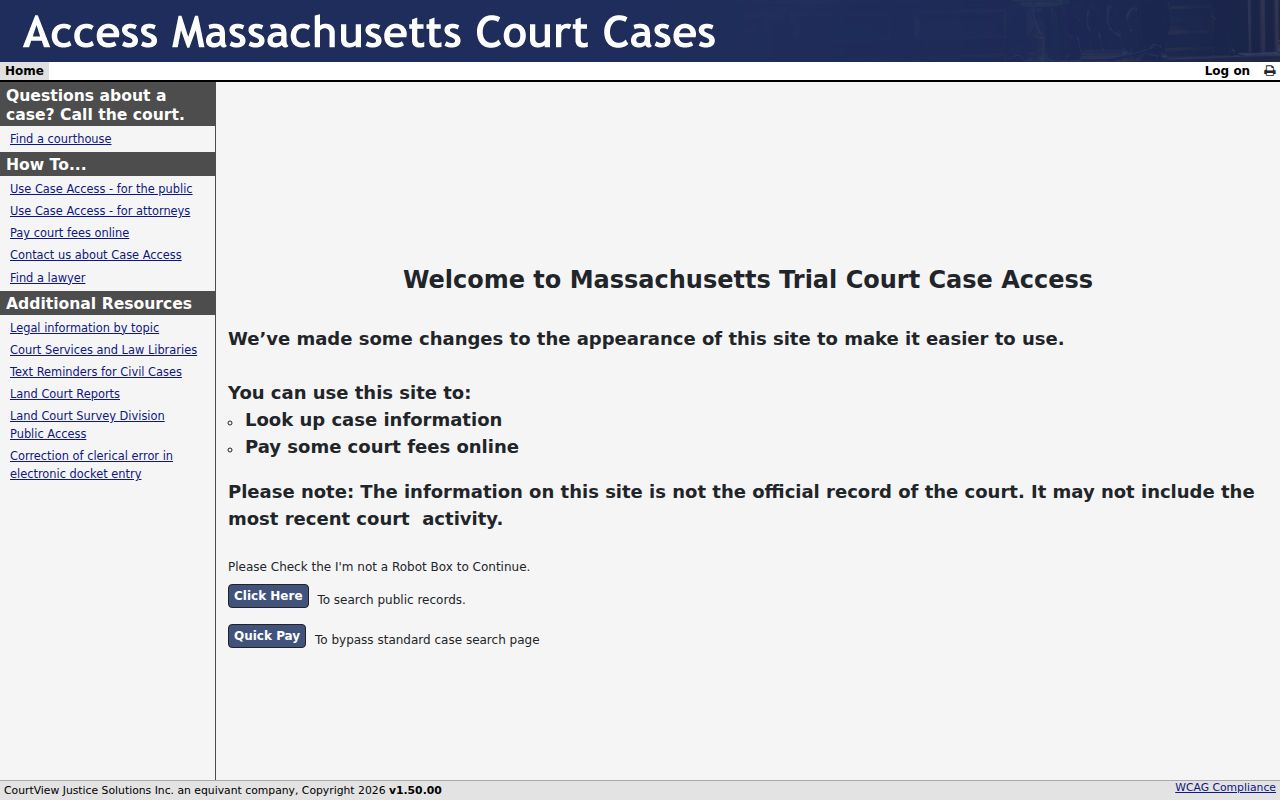
The tabs and filtering choices shown there are a starting point for a specific case question, not a list of Agawam residents.
The Westfield District Court location page confirms the court that serves Agawam.
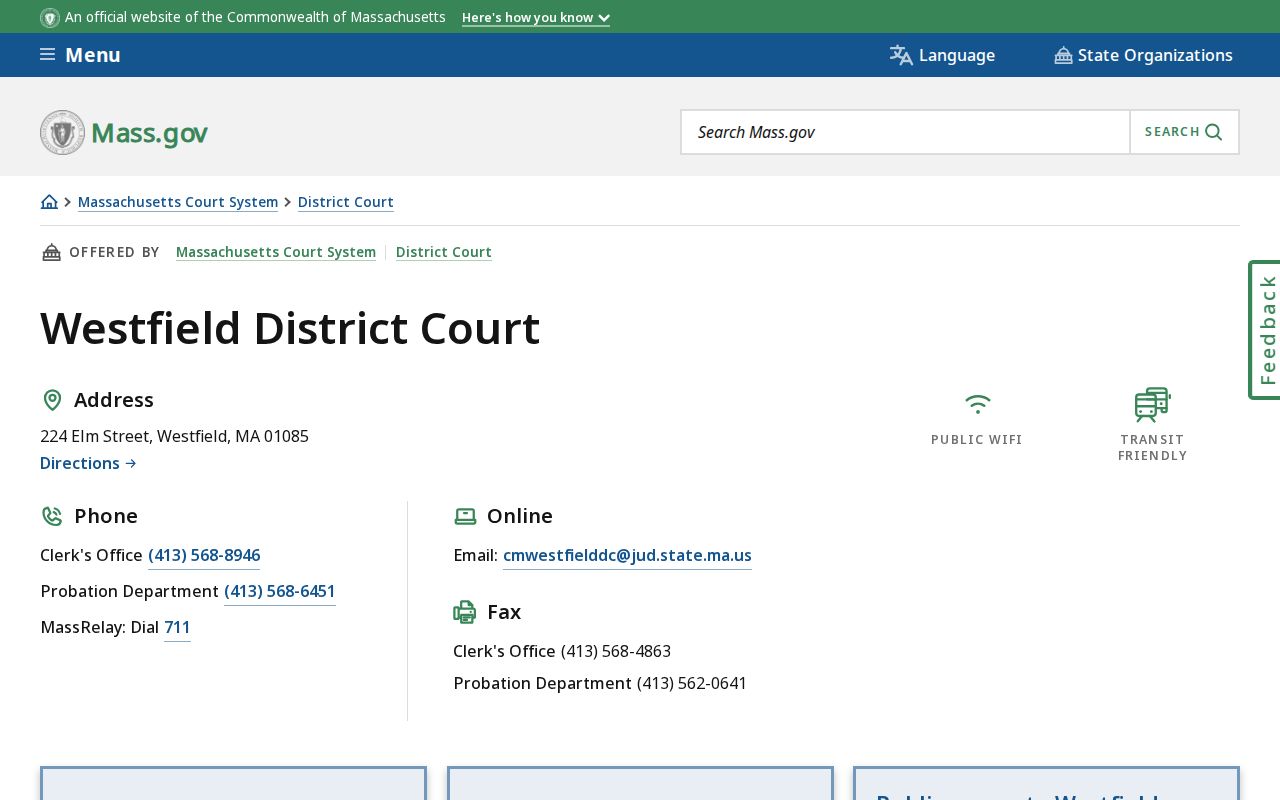
Use the court name, case number, type, status, and relevant date when asking a clerk about a public record.
Verify an Agawam Resident Record
A defensible verification follows one person through records with different purposes. Begin with the relationship that can actually be tested. For example, an estate question may begin with a Probate docket, while a past school connection may begin with an Agawam Library yearbook or graduate list. Do not convert a search match into a conclusion until another identifier agrees.
- Choose one official anchor, such as a parcel identifier, deed book and page, court docket, certificate index, or class year.
- Search the full name and documented variants, then preserve the record date and the field that created the match.
- Cross-check a different source, such as a directory address plus a deed, or a probate file plus an eligible death-record route.
- Request a copy only from the holding custodian when the original record is needed, and ask about eligibility or certification first.
- Docket
- The court’s index of a case, its parties, and recorded events. It is not the entire file.
- Index and image
- An index points to a record; an image is the scanned document. Either may have different access limits.
- Certified copy
- A copy issued by the custodian with official certification, often requested for a formal transaction or filing.
Agawam Vital-Record Paths
Birth, marriage, and death research has a local, state, and archival split. The Agawam Clerk may hold local records, the Massachusetts Registry of Vital Records and Statistics handles state-held material, and older material may be in the Massachusetts Archives or local custody depending on the period. Where a marriage intention was filed can matter as much as where the ceremony happened. Divorce records follow the court route instead of the certificate-order route.
Massachusetts generally places births and marriages older than 90 years, and deaths older than 50 years, outside the ordinary restriction period. That does not erase other limits. M.G.L. c.46 §13, M.G.L. c.46 §2A, and 105 CMR 305 still govern special records, identity and relationship questions, adoption and unwed-parent information, and protected details. Historical indexes and newspaper notices are useful supporting evidence, but they are not certified records.
The state’s certificate-order instructions set out record type, subject details, identity or relationship documentation, payment, and delivery steps.
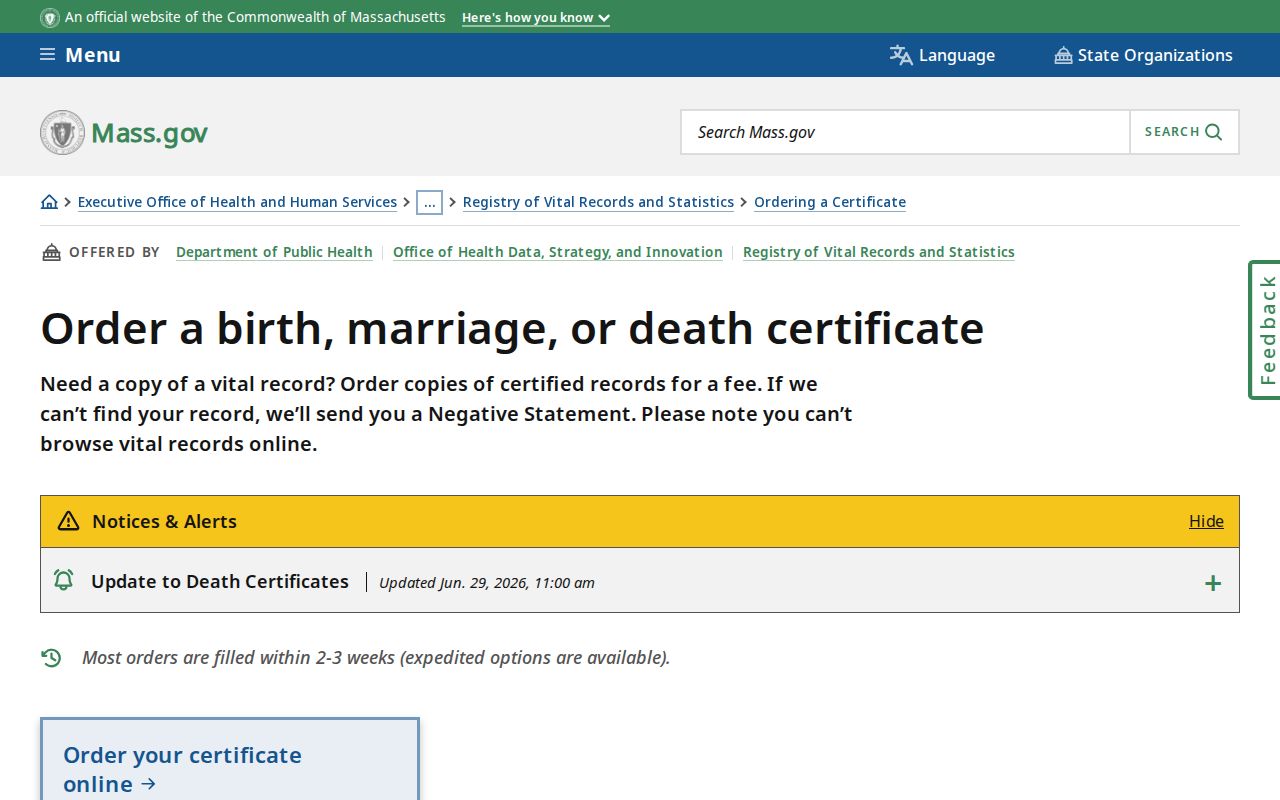
Use that official route or the Town Clerk for an eligible order, rather than a general request intended to bypass certificate rules.
Note: Vital-record age thresholds affect ordinary access, but special statutory restrictions and requester eligibility can still control a particular certificate request.
Agawam Voter Lookup Boundaries
The state Where Do I Vote form is an address-to-polling-place tool. It asks for a street number, street name and suffix, then a municipality or ZIP, and returns polling and election information. It does not return a resident list. Keep precinct information as geographic context, especially because Agawam has eight precincts and Precincts 6 and 8 share Clark School.
Municipal voter files can contain limited public name, address, party, date-of-birth, status, voter-ID, registration-date, and change-history fields under state guidance. Phone, email, veteran status, permanent-absentee status, confidential-voter records, and minors’ information are protected. A statewide voter list is not an ordinary public list. A narrow request to the Agawam Clerk should state the time period, requested public fields, delivery format, and lawful purpose.
The official polling lookup shows the address fields used for Agawam polling geography.
The result is useful for a polling-place question, but it does not identify voters at nearby addresses.
The Secretary’s voter-information access guidance separates public fields from nonpublic and confidential categories.
That distinction is why a voter record must be treated as a dated, limited registration record rather than a complete household profile.
Agawam Historical Identity Clues
For an old address or a former classmate, the Agawam Library local-history collection is the more suitable trail than a current-name search. Its reference materials include directories, yearbooks, graduate lists, newspapers, town reports, maps, photographs, local books, and vital-record resources. Some database access is limited to the library. A yearbook connects a name to a school year, not to a current address.
Local labels can complicate a resident lookup. Agawam Center, North Agawam, and Feeding Hills may appear in directories or postal material. Record the original locality label rather than silently replacing it. The historical collection also warns that a current address may not be the original address, so a no-hit directory search can call for a map, deed description, or alternate address form.
Note: A printed directory or yearbook establishes only the association and date shown in that publication, not a continuous history before or after it.
When an Agawam Resident Lookup Ends
Some information is not available through an ordinary search. Current non-owner occupants, private utility customers, delivery records, RMV address data, protected voters, sealed cases, and many modern vital details are outside the public path. A commercial people-finder category may combine public and purchased data, but its matching, dates, fees, and opt-out process are not a substitute for an identifiable official source.
For an heir question, use the Probate route and then read the public petition, will, inventory, or notice if available. For adoption or birth-parent questions, use Massachusetts’s official confidential-information procedures. For a historic classmate, use the library’s yearbooks and local history resources without publishing modern contact details. The best outcome is often a well-documented boundary, not a forced identity match.
Legal Limits for Agawam Resident Lookup
Massachusetts public-records access is governed by the Massachusetts Public Records Law, G.L. c.66 and G.L. c.4 §7(26), with 950 CMR 32. Agawam describes a 10-business-day response framework, possible extensions, fees, redactions, and an appeal route. A request can seek an existing record, but a custodian does not have to create one or answer a broad research question. Contact the office that holds a suspected error rather than changing or republishing it.
The Massachusetts Address Confidentiality Program, under M.G.L. c.9A and 950 CMR 130, uses a substitute-address and mail-forwarding process for eligible survivors. Confidential-voter protections also apply. These limits exist alongside sealed and restricted court and vital records.
Lawful use. An Agawam resident lookup is for personal, lawful research such as family history, estate work, reconnecting, or checking an official record. Do not use records to stalk, harass, intimidate, or harm anyone.