
Agawam Directory Holdings
Historical research starts with the Agawam Library local-history collection, a reference collection of books, vital-record leads, maps, photographs, pamphlets, newspapers, directories, yearbooks, graduate lists, and town reports. Its materials are a historical shelf, not a current resident register. The Massachusetts State Library and archival catalogues add important coverage, especially when a local copy or a digitized issue is not immediately available. The practical route is library reference first, then the State Library, Archive.org or microfilm and archive holdings for the edition needed.
| Collection | Years | Where held | Access |
|---|---|---|---|
| Agawam directories | Selected 1897-1968 | State Library holdings and local reference leads | Confirm edition and in-library or archival access |
| Feeding Hills directories | 1926, 1933, 1935, 1938, 1941, 1966, 1968 | State Library and local-history search | Selected years only |
| Springfield Suburban / Manning | 1904-1928, 1931-35, 1938-49, 1953-58, all with gaps | Microfilm catalogue, library, and archives | Catalogue-confirmed coverage |
| Agawam Mirror and Advertiser | Mirror: selected 1927-1970; Advertiser: 1971-2018 | Library database links and digitized archive | Digitized access varies; 1971-77 needs the library workaround |
The selected runs are useful precisely because their limits are stated. A city directory can place a name and printed address in a particular edition, but it should never be treated as proof of present occupancy or as an uninterrupted annual record.
Note: Record the title and year before drawing any conclusion from a historical listing or a missing result.
Agawam Directory Year Runs
The inspected State Library list places Agawam editions across selected years from 1897 through 1968. Feeding Hills also appears as a locality of Agawam in several separate editions. That distinction matters when a search only uses one place name. The Massachusetts State Library genealogy guide describes city and town directories as commonly alphabetical by name and potentially useful for historical addresses, businesses, advertisements, and sometimes street or house guides.
For a broader title, the Springfield Suburban or Manning microfilm catalogue includes Agawam, Agawam Center, Feeding Hills, and North Agawam. Its intervals are not continuous. The listing identifies 1904-1928, 1931-1935, 1938-1949, and 1953-1958, each with gaps. A researcher should note the nearest available before and after year instead of silently filling the interval.
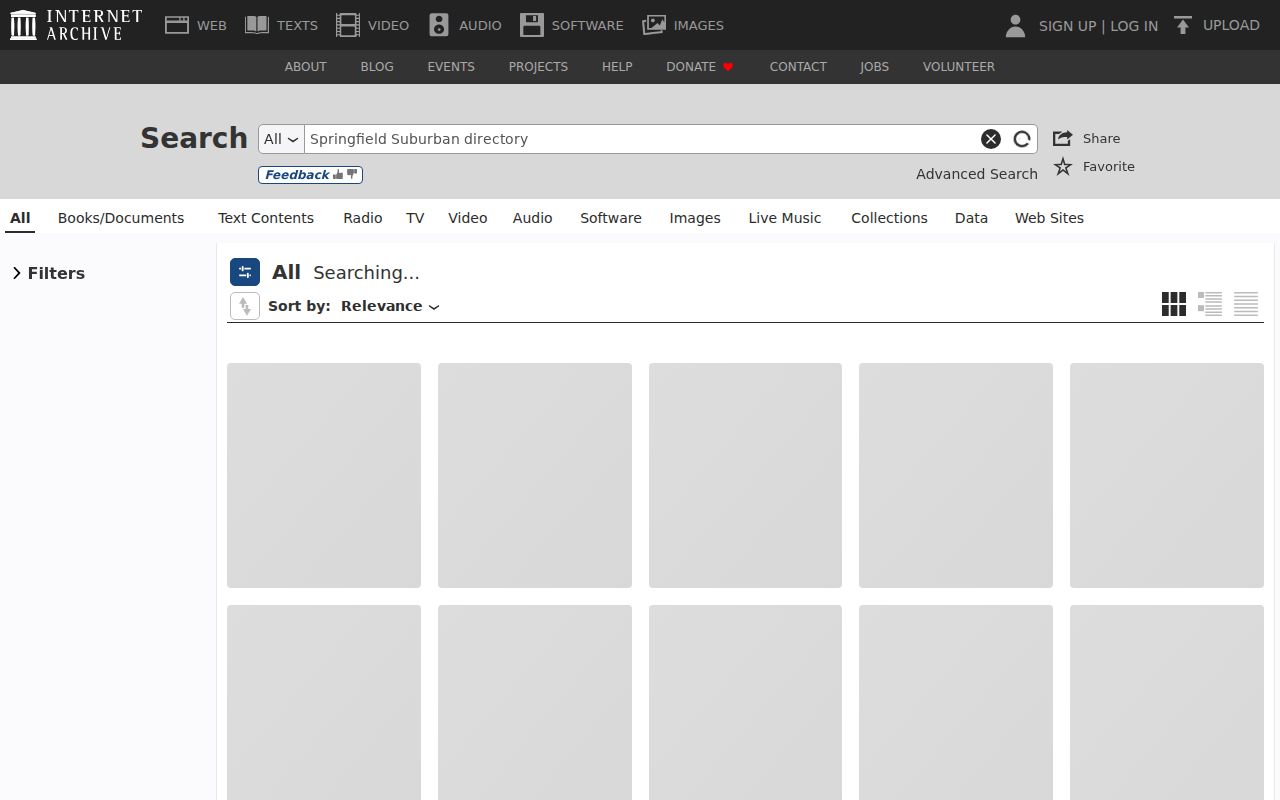
A Springfield Suburban directory search at Archive.org illustrates the digitized discovery route, but the accessible search result did not provide a readable Agawam entry page. The captured view is useful for locating a title, not for transcribing a household.
The Archive.org search view is a starting point for a historical Agawam city directory title.
Agawam Library Directory Access
At the local library, the direct starting point is the local-history reference collection. It combines printed material with a house-history workflow and links to digitized newspapers, yearbooks, town reports, and other research databases. Reference access matters because the collection is not a promise of a complete online run. Ask for a specific title, date, locality label, and whether a reader, microfilm or archive request is needed.
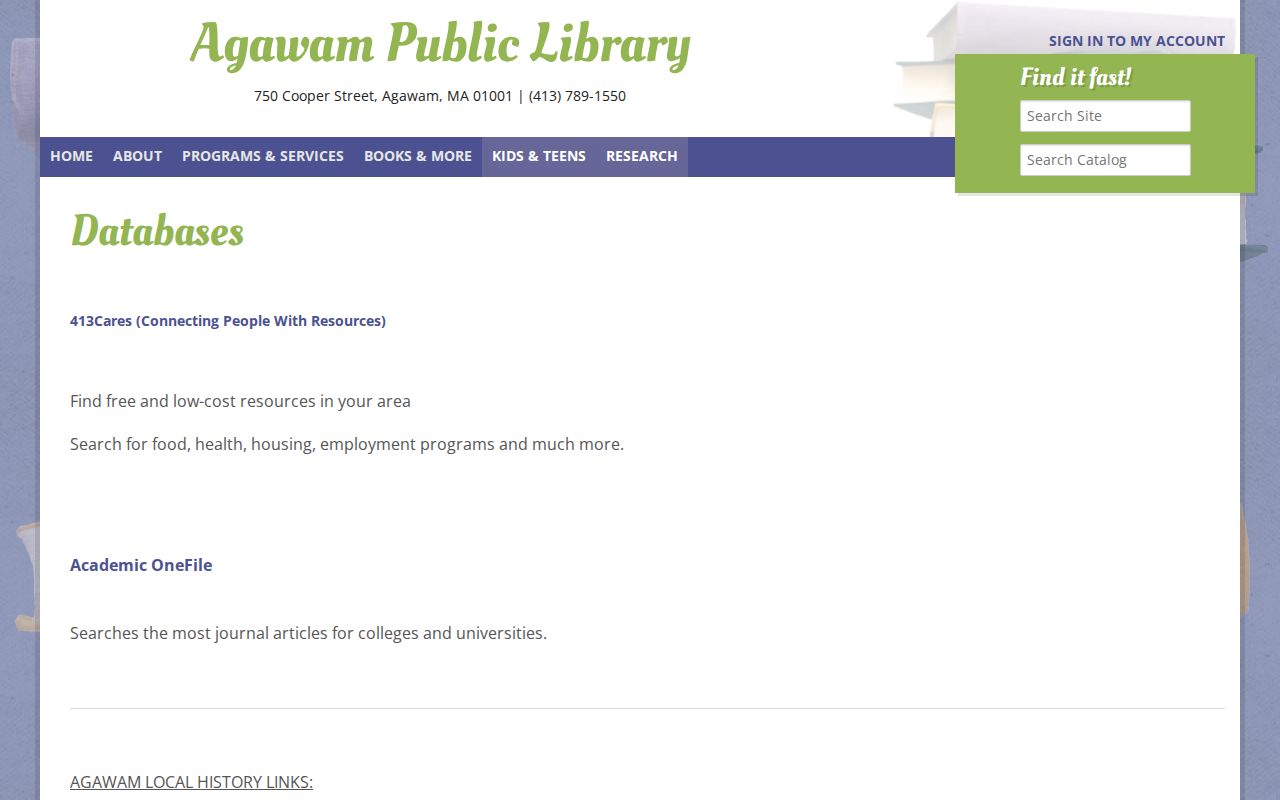
The library database page links researchers toward Archive.org and local digitized material. Agawam High School yearbooks cover 1927-2022 in the collection information, while the database page says coverage reaches through 2025. Junior-high yearbooks run from 1973-2007, and town reports are listed from 1891-1984. Those items are companion evidence, not replacements for a directory entry.
The local digitized research links show the library's routes to newspapers, yearbooks and town reports.
Use the library, State Library, Archive.org search, and microfilm or archive holdings as a fallback chain. Each route answers a different access problem, so an unsuccessful web search is not the end of the collection search.
Reading an Agawam Directory
A readable Agawam directory-entry page was not captured during the research pass. That is an important limit. The available catalogue verifies titles, publisher context, locality labels, and coverage gaps, but it does not establish which fields a particular Agawam edition printed. Inspect the relevant page and its abbreviation key before recording a relationship, business detail, or other notation.
| Directory title and year | Record the publisher, edition and year exactly as printed. |
|---|---|
| Name | Copy spelling, initials, honorifics and any notation only after viewing the page. |
| Address and locality | Preserve the street number, street spelling and locality label exactly. |
| Second listing or cross-reference | Record the printed wording, then avoid inferring a relationship unless the source states one. |
| Page and key | Keep the page number and the volume's abbreviation key with the notes. |
- Criss-cross directory
- A directory section arranged by street or address rather than by surname, when a volume includes one.
- Householder index
- An index that may group a household under one named entry; its scope must be checked in the volume.
- Abbreviation key
- The printed explanation of shorthand used in that edition. Photograph or transcribe it with the entry.
Some directory series can contain work, address, household, business, or street-guide information. Those are inspection targets, not claims about a specific Agawam entry. The city directory evidence gap remains until a direct page is read.
Agawam Directory Locality Names
Agawam, Agawam Center, Feeding Hills, and North Agawam can all appear in a historical search trail. These are not interchangeable spelling errors. A printed locality may reflect a directory publisher's organization, a neighborhood identity, or a postal-era label different from the one used today. Search each one alongside surname variants, first initials, and a street name without its suffix.
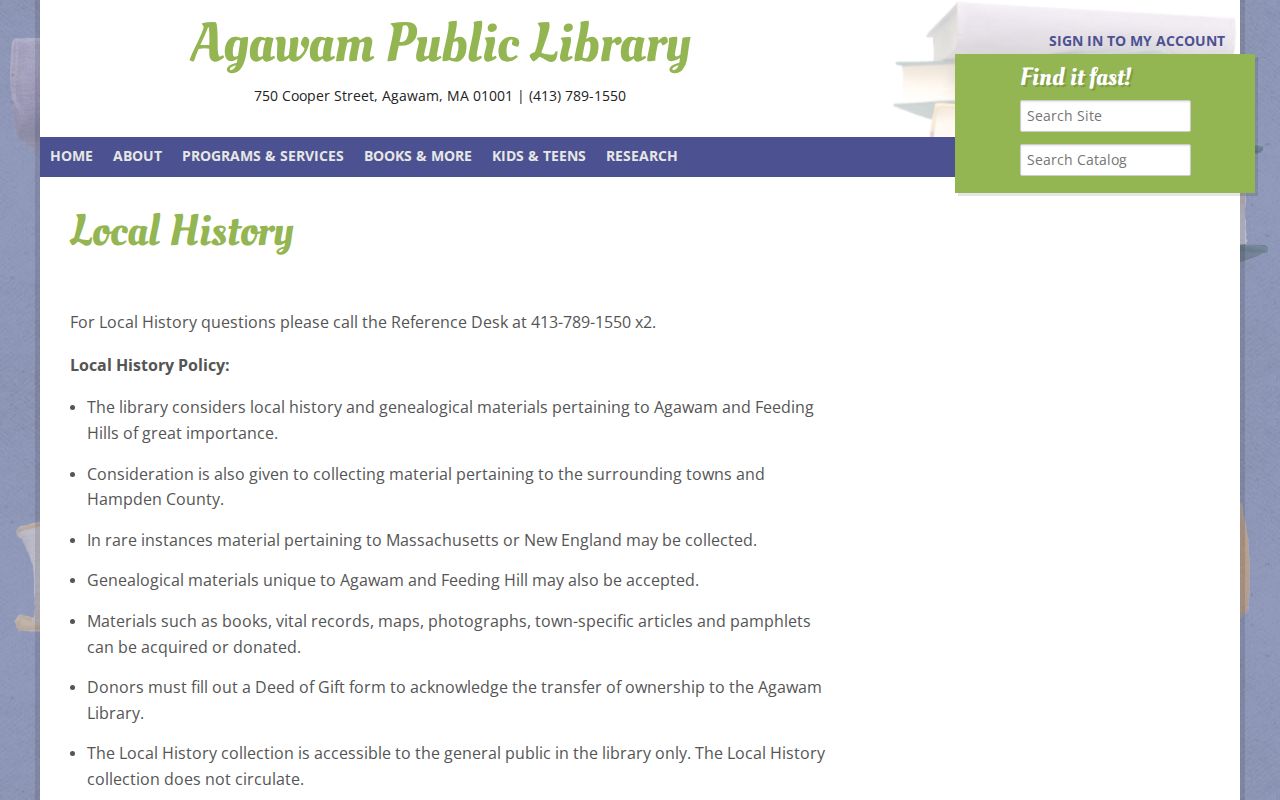
The same care applies to address changes. The library's house-history guidance warns that a current address may not be the original address. A deed's legal description, an old street name, a map, or an address-change note may bridge the difference. Preserve the source wording first and add a normalized field separately, rather than replacing a historic label with a modern one.
The library's local-history and house-history materials set out the research path for reconciling present and earlier address information.
Note: A source gap or a changed locality label is not evidence that a household did not exist.
Agawam Directory Gaps
Missing editions are a feature of the evidence, not a statement about the people who lived in Agawam. The Manning catalogue has gaps in every listed interval, the Agawam Mirror has separated runs, and digitized access varies by title. The Agawam Advertiser is listed from 1971-2018, with a library workaround for 1971-1977. A no-hit result should be written as “no hit in the inspected source and year range,” never as a conclusion about a household.
The record-keeping timeline also explains why several sources must be paired. Selected Agawam directories begin in 1897. Town reports reach back to 1891 in the library listing. The library connects newspapers and yearbooks to those paper records, while present-day tools are separate digital systems. No inspected official source identified a complete local records-loss event, so an invented fire or destruction story would be less accurate than the documented coverage gaps.
- 1891: Agawam Town Reports begin in the listed local collection.
- 1897: Selected Agawam directory holdings begin in the inspected State Library list.
- 1904-1958: Springfield Suburban or Manning coverage supplies several gapped intervals.
- 1971-2018: The library lists the Agawam Advertiser, with a separate workaround for 1971-1977.
Tracing Agawam Household Directories
Use city directories as a sequence of dated checks, then pair each check with another source that answers a different question. A federal census gives a household snapshot under the federal 72-year release rule. A deed identifies a recorded transfer, not a move date. A yearbook, town report, newspaper, probate index, or naturalization record may supply context. The goal is a small, cited timeline, not a broad profile of a current person.
- Locate the earliest available edition for the surname, initial and locality variant.
- Copy the printed name, address, title, year, page and abbreviation key exactly.
- Check the next available edition before and after it, noting gaps rather than inventing an annual sequence.
- Pair the dated address association with the appropriate released census year or another independent local record.
- Use a deed, probate, newspaper, yearbook or town report only for the relationship it actually documents.
A directory disappearance can reflect a move, death, changed label, unlisted year, or a different editorial choice. It does not explain itself. When a historic name needs modern confirmation, a carefully limited Agawam resident lookup can focus on the exact record relationship instead of assuming that a directory entry proves a present connection.
Agawam Directory Companions
Yearbooks, graduate lists, newspapers and town reports are especially useful around a directory year because they preserve different kinds of local context. High-school yearbooks and graduate lists can help identify a class-year connection. Town reports can anchor public works, municipal activity and aggregate events. A newspaper may supply a dated notice. None should be silently converted into proof that a person lived at a particular address.
The library is the main keeper for these companion materials, but the State Library, archival collections and microfilm remain part of the search route. For a historic building or corridor, maps and the house-history research sheet can keep structure history, parcel history, occupants found in directories and owners found in deeds as separate facts.
Note: Match every companion source to its own date and purpose before combining it with a directory finding.
Agawam Historic Resource Context
The Agawam Historical Commission offers a public route into historic-resource research and the MACRIS context. Research notes identify more than 500 historic resources and six National Register listings. Those resources can place an address within a civic, agricultural, mill, streetcar, or automobile-era landscape, but they do not identify a household by themselves.
The official Historical Commission resource route provides a useful companion to historical Agawam city directory research.
Feeding Hills can suggest an agricultural and large-landscape setting, North Agawam a mill-related setting, and Springfield Street a streetcar-suburb corridor. These are research contexts, not shortcuts for naming occupants. The strongest historical conclusion names the precise source, date, locality and record relationship.