
Finding Agawam Resident Records
An Agawam residents directory works best as a chain of official records, not as one master list. Start with the type of connection that matters. A current parcel question belongs with the assessor and GIS. A recorded transfer belongs with the Hampden Registry of Deeds. A historical household may appear in a library directory, yearbook, newspaper, or town report. The Town Clerk holds municipal records, including elections, local certificates, business certificates, licenses, and annual census material. Each source has its own date and meaning, so an owner field should not be treated as a statement that someone occupies the property.
For a name, preserve spelling variants, initials, former names, and a rough date range. For an address, keep the number, street suffix, ZIP label, municipal locality, and parcel ID separate. Agawam, Feeding Hills, North Agawam, and Agawam Center can appear as different labels in the same historical trail. A result is strongest when a second source with a different purpose supports it. That approach protects against a same-name mix-up and makes a residents directory search easier to reproduce later.
- Validate an address in the USPS ZIP lookup, then record its postal label without assuming it defines the city line.
- Open the Agawam Assessor route and the GIS viewer to capture the parcel ID, situs address, and owner-of-record context.
- Use the Hampden Registry of Deeds to check the associated recorded transfer, book/page, parties, and legal description.
- For an older household, consult the library and State Library directory, newspaper, town-report, or yearbook collections for the date in question.
- When an existing municipal record is offline, send a focused request to the right custodian with the subject, record type, date range, and desired delivery format.
Agawam Residents Directory Offices
Agawam sits in Hampden County, although Springfield is the county seat. That split explains why municipal, land, court, and statewide records have different keepers. The Town Clerk is the local starting counter for city-held records. The assessor and the Tighe Bond GIS viewer give the address and parcel layer. The Registry handles deeds and other recorded instruments. State election tools describe polling geography, while a municipal voter-file request is the proper route for lawfully available dated list fields. The address-focused sequence is covered in more detail on the Agawam street directory page.
Hampden Registry of Deeds
Springfield and Westfield offices
Hampden County, MA
(413) 755-1722
Agawam Clerk and Elections
36 Main Street
Agawam, MA 01001
(413) 786-0400 ext. 8215
Agawam Parcel Records First
The Assessor page links the local property-card route with the town's GIS and deed tools. The VGSI landing page identifies an online assessment database, although the accessible version did not confirm every live search field. The town explains that a property card can hold building size and type, construction quality, rooms, baths, fireplaces, heating, land area, location, and permit-related facts. Its FY2026 context reflects 2024 sales and a January 1, 2025 assessment. Assessed value is a tax value, not a sale price or title opinion.
Use the parcel ID as the join key. Keep a physical situs address apart from the owner mailing address, then compare both with the legal description on the recorded instrument. The Agawam GIS viewer exposes search suggestions, identify, parcel details, adjacent-parcel and abutter tools, printable reports, and measurement controls. Those map relationships locate land. They do not identify every person at an address.
See the Agawam Assessor landing page before opening the property tools.
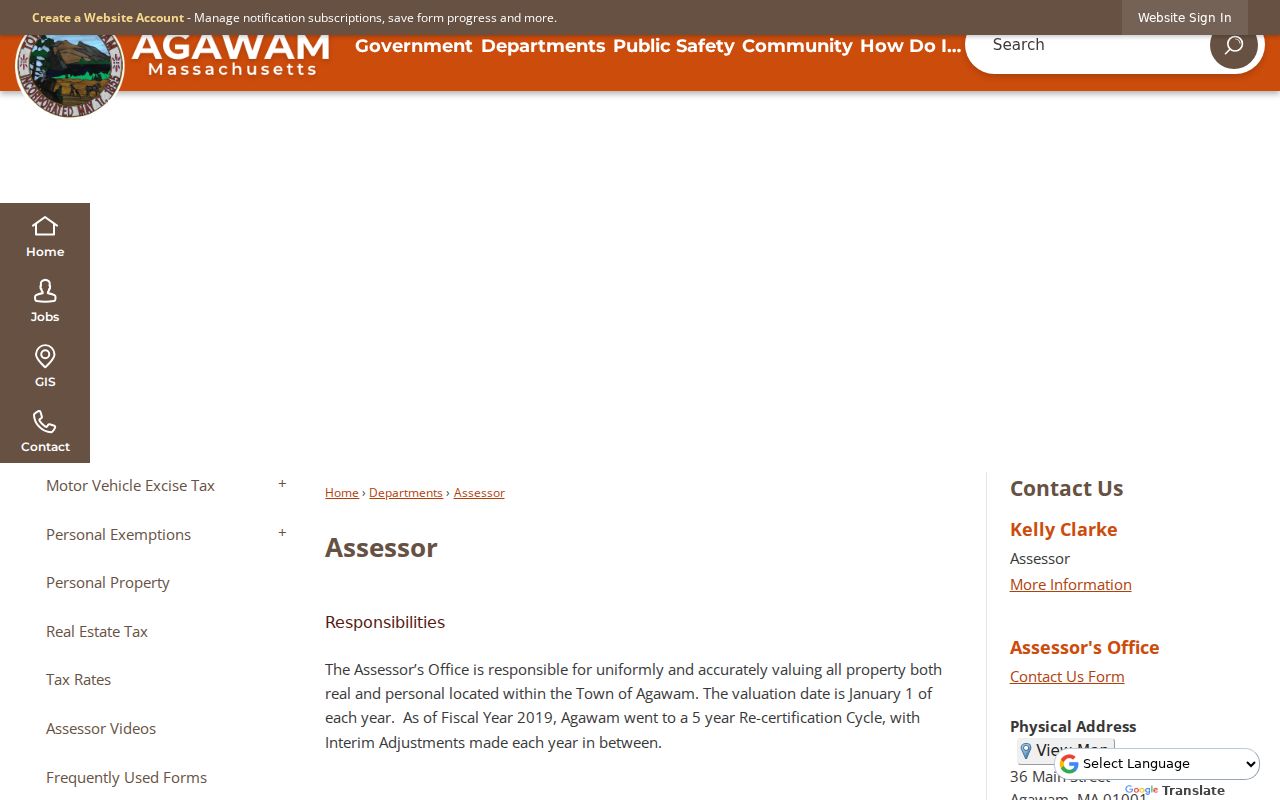
The page directs a researcher to the local property-card, GIS, and deed paths that turn one address into a documented record trail.
Note: Dynamic assessment-card controls should be checked live before relying on a field label or a current value.
Agawam Assessment Directory Fields
The assessment database is useful when a resident-search question is really a property question. Record the fiscal year with each item and do not collapse a parcel owner, a mailing address, and an occupant into one label. Sale and permit references on a card should be cross-checked against the Registry or the responsible department. An empty field may be a database condition, not a finding about the property.
| Assessment item | Why it belongs in the record trail |
|---|---|
| Parcel ID | Joins GIS, assessment, and deed research; retain leading zeros and punctuation. |
| Situs and mailing address | Separates the parcel location from a tax correspondence destination. |
| Owner field | Shows the assessment record's owner of record, not a complete occupancy list. |
| Land and building values | Provides the assessment context for a stated fiscal year. |
| Sale or permit references | Supplies leads that need confirmation in the deed image or department file. |
The VGSI assessment database is the official online entry point captured for this project.
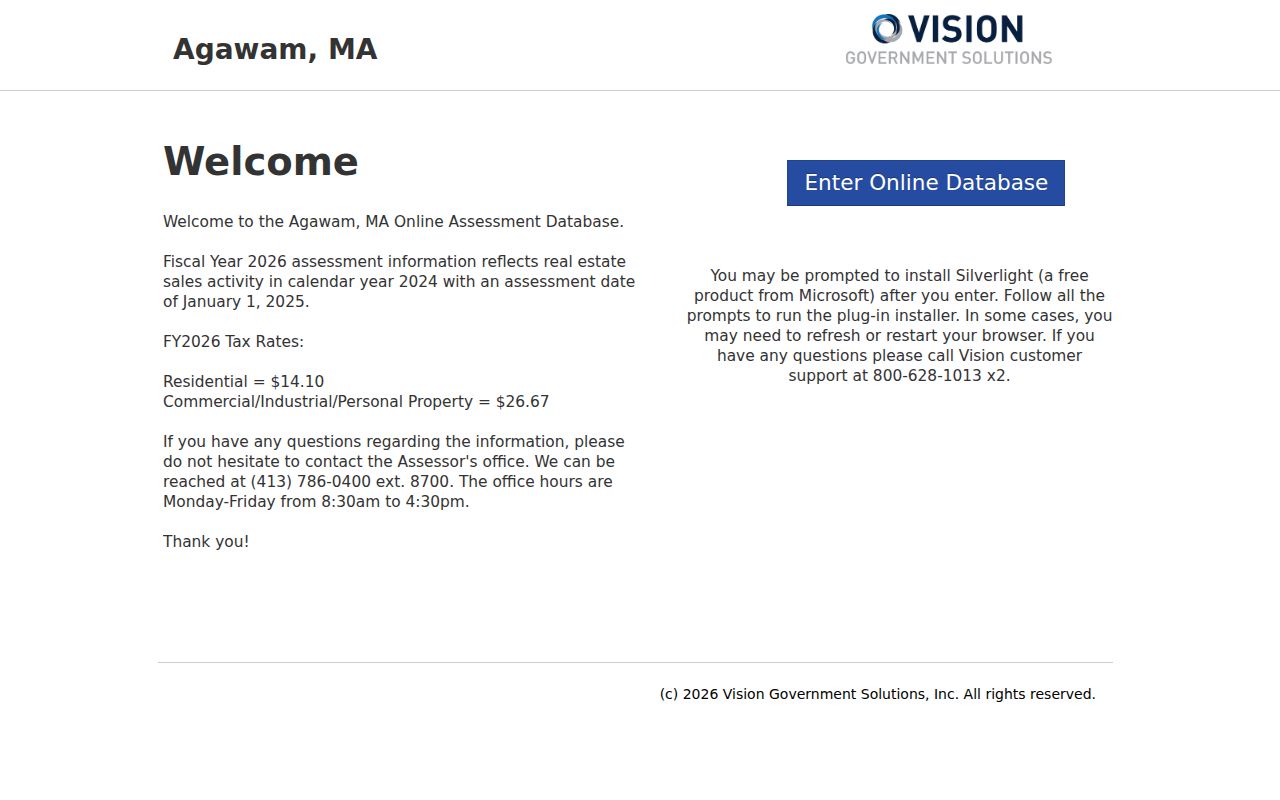
The captured landing view confirms the assessment route while leaving some dynamic form controls for a live session.
Current Agawam Resident Directories
Current directory-like sources each prove a narrower relationship. Assessment records tie an owner-of-record field to a parcel. The Registry links named parties to a recorded instrument. A municipal voter file can contain limited public, dated registration fields when lawfully obtained, but the statewide polling lookup only returns polling-place and election information. The Clerk also keeps local certificates, business certificates, licenses, and municipal census material. A business address or a court party is not automatically a residential address.
| Agawam source | Relationship shown | Custodian | Access route |
|---|---|---|---|
| Assessment and GIS | Owner field, parcel, situs, map context | Agawam Assessor | Web tools, office, or defined request |
| Deed index | Grantors, grantees, instrument dates | Hampden Registry | Free index/images, paid certified copy |
| Municipal voter file | Dated permitted registration fields | Agawam Clerk | Local request subject to state guidance |
| Court docket | Party role, case type, docket events | Relevant court clerk | MassCourts or counter, with restrictions |
| Local history collections | Historical name or address association | Agawam Library | Reference, digitized, or archive path |
Choose a source according to the precise question. A one-person confirmation needs a name variant and an independent second record; the Agawam resident lookup page keeps that workflow separate from address and household history. A full municipality-wide voter list is not supplied by the polling-place tool, and protected voter information is not public.
Agawam Voter Record Boundaries
Massachusetts separates the address-based polling lookup from a voter-record request. The Where Do I Vote form asks for street number, street name, suffix, and either city/town or ZIP, with language tabs and a search button. It returns polling-place and election information. It does not list the people who live nearby. Agawam has eight precincts, a useful geographic clue that should be dated because election districts and polling sites can change.
State guidance says municipal voter data can contain limited public fields such as name, address, party, date of birth, active or inactive status, and voter ID. Phone, email, veteran status, permanent-absentee status, confidential-voter information, and minors' information are not public. Ask the Clerk for a specific date range, field set, delivery format, and lawful purpose rather than trying to turn a polling tool into a residents directory.
See the Agawam Clerk responsibilities page for the local counter that handles elections, certificates, licenses, and municipal records.
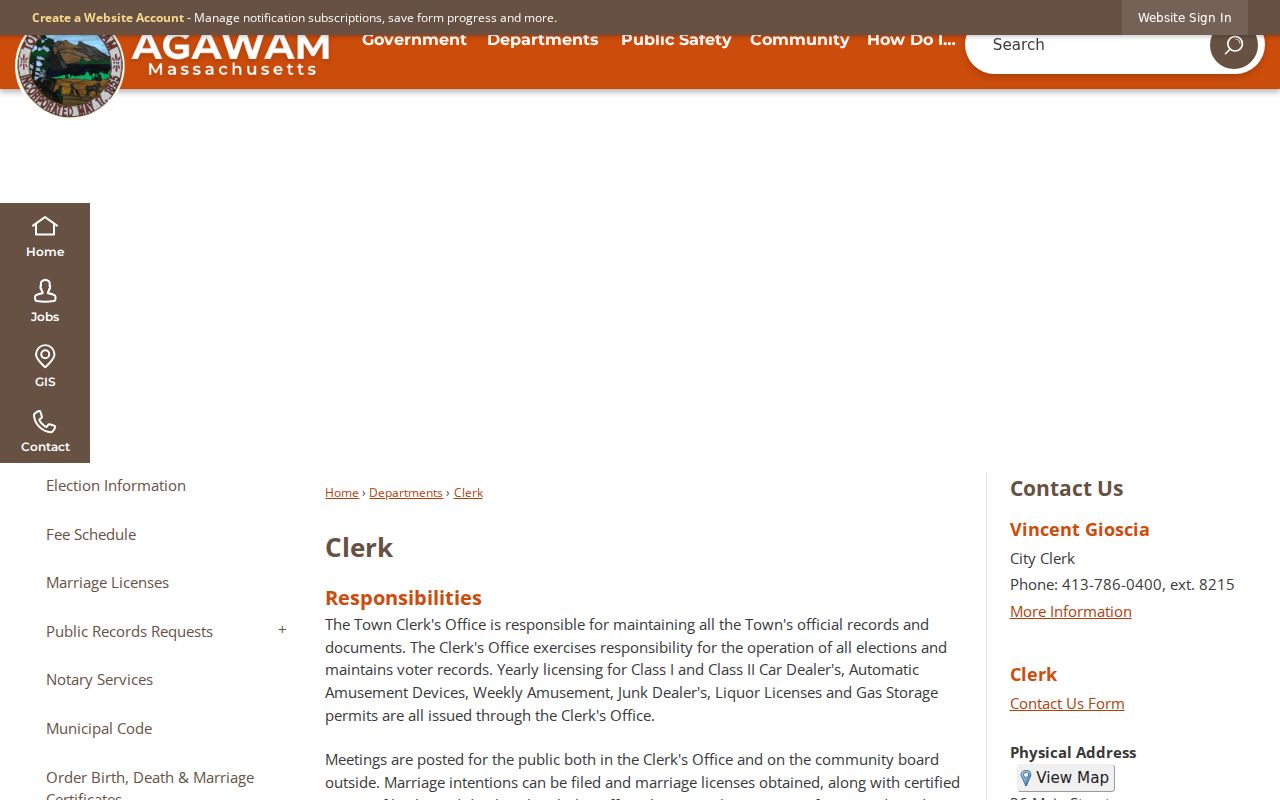
The municipal page shows why a local records counter can be a better fallback than an incomplete online search.
Agawam Deed Index Trails
The Hampden Registry is the county source for recorded deeds, mortgages, releases, liens, easements, plans, and related instruments. Current Registry instructions describe fully indexed searching after 1948 by name, address, book and page, year and instrument number, or entry date. Earlier work uses scanned grantor and grantee indexes, then the book/page image. The Registry history reaches back to 1636, but an early record may need county-custody context before it is joined to a particular parcel.
A grantor is the party transferring an interest; a grantee is the party receiving it. Read the image rather than relying only on an index label. Save the instrument type, execution and entry dates, book/page or instrument number, legal description, plan reference, and any prior-deed citation. The Registry supplies free online images, while certified copies carry a charge. The image is research evidence, not a formal title opinion.
Begin at the Hampden Registry of Deeds before moving to a name or address search.
The Registry's official page is the proper place to check current digitization and copy guidance before trusting a mailed deed solicitation.
Agawam Name and Court Records
MassCourts eServices is the statewide public entry point for a narrowly defined court question. Its public search uses a CAPTCHA, then court department, division, location, and search tabs for name, case type, case number, or ticket. The official guide describes a last name of at least two characters and a first name of at least one for name searching. A docket can establish a court, party role, case type or status, and dates. It does not establish a person’s home address or the truth of an allegation.
Westfield District Court is Agawam's district route. Hampden Superior and Probate and Family matters generally route to Springfield. Remote access varies by court department and record type, and criminal remote searching generally requires a case number. Sealed, impounded, juvenile, expunged, adoption, abuse-prevention, and harassment material can be unavailable. When public material is indexed but not remotely viewable, the clerk or register is the appropriate next channel.
The MassCourts public-search landing page shows the official starting interface.
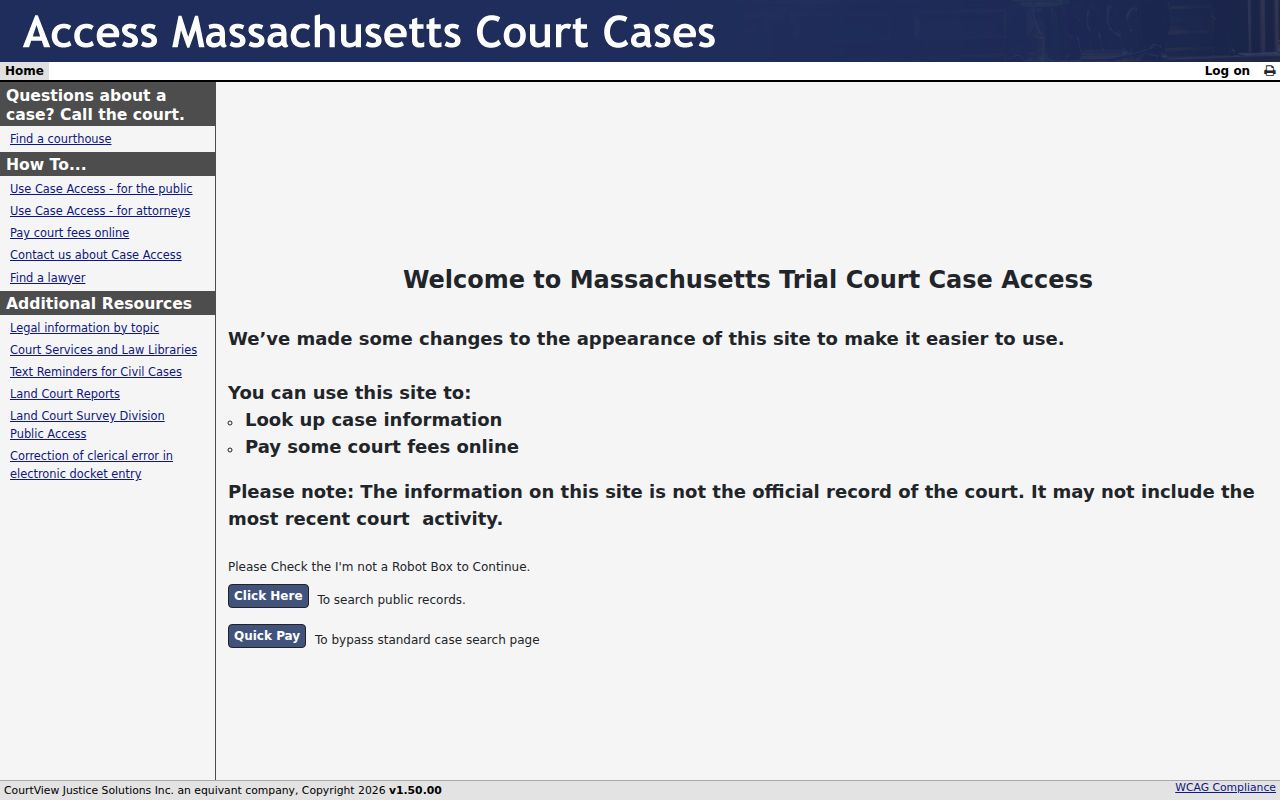
The public search screen makes clear that court research begins with a defined court question, not a broad claim about a resident.
Note: Save the court, division, docket number, result date, and access channel with any lawful court research.
Agawam Public Records Channels
When no public index exists, Agawam offers several ways to request existing municipal records. The town's Public Records Requests page links to its online portal and PDF form. Requests can also be made in person, by first-class mail, fax, email, or phone. The Town Clerk is at City Hall, 36 Main Street, and ordinary weekday hours listed in the research are 8:30 a.m. to 4:30 p.m. Record-specific hours can differ.
Massachusetts Public Records Law, G.L. c.66 and G.L. c.4 §7(26), is implemented through 950 CMR 32. The town says a requester need not give a purpose, but a focused description improves retrieval. Name the custodian, subject, record type, date range, and desired delivery. The guidance describes a response framework of 10 business days, possible redaction, fee estimate, or extension, with an appeal path to the Supervisor of Records. A custodian need not create a record or answer a historical question.
Open the official request channels page to select the current municipal route.
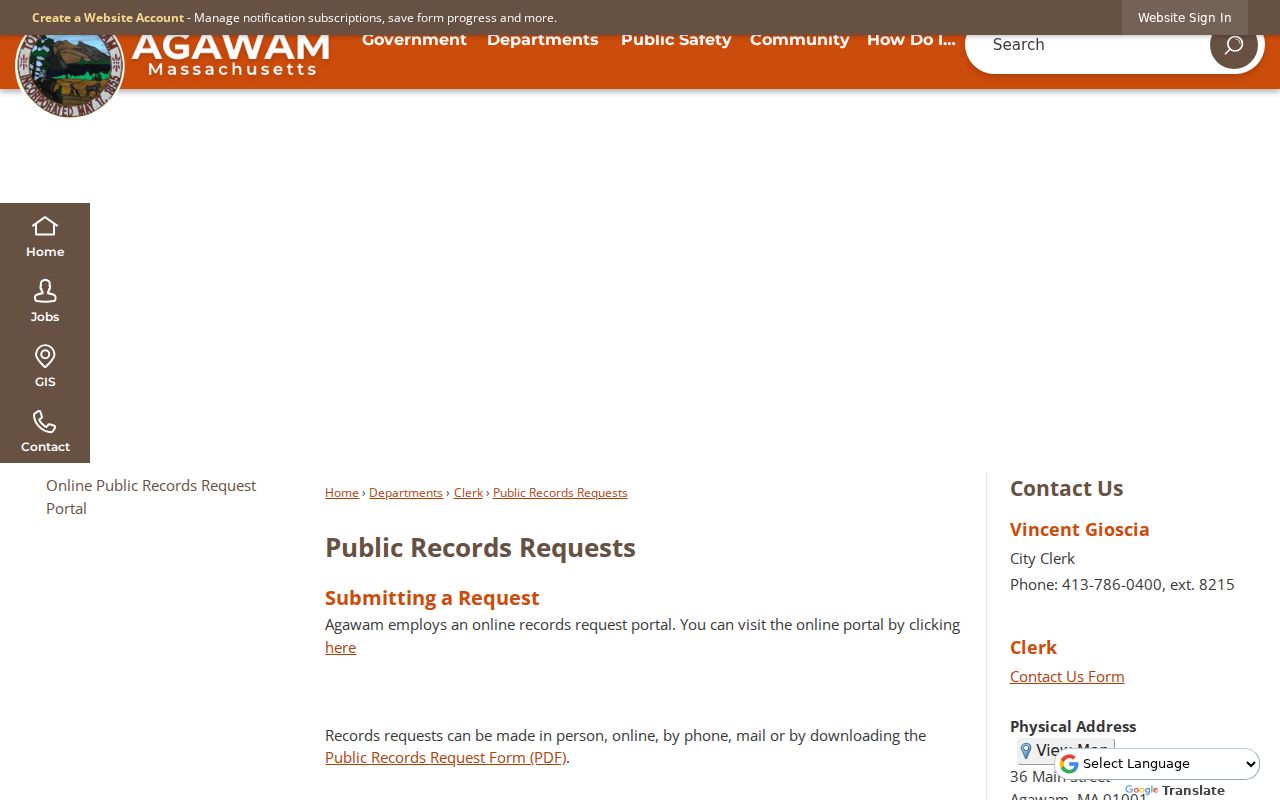
The captured page ties the online portal, form, and non-web request channels together for records held by city departments.
Historical Agawam Resident Directories
Agawam’s historical directory shelf is a dated, uneven collection, not a complete timeline. The State Library lists selected Agawam directories from 1897 through 1968. Feeding Hills appears for 1926, 1933, 1935, 1938, 1941, 1966, and 1968. The Springfield Suburban or Manning title includes Agawam-area localities in runs from 1904 through 1958, with gaps. Agawam Library also identifies town reports from 1891 through 1984, digitized newspapers, yearbooks, graduate lists, maps, and photographs.
A directory can provide a printed name and address association for its edition year. It cannot prove a current occupant, and a missing edition does not prove that a household was absent. The full collection list, locality variants, and tracing method appear on the Agawam city directory page. For house history, pair the directory year with a deed, parcel, map, newspaper, or later census release instead of treating one printed line as a complete household record.
Agawam Library History Sources
The Agawam Library local-history collection is the main public shelf for a historical people or place question. Its materials are generally reference resources, and its database links can lead to Archive.org, newspaper collections, genealogy services, yearbooks, and town reports. Digitization is uneven. That limitation is useful: record the actual title and years checked rather than turning a no-hit into a conclusion about a person or property.
- Roll
- A dated list maintained for a particular administrative purpose, such as assessment or voting.
- Index
- A finding tool that points to a record or image; it is not always the complete document.
- Parcel
- A mapped unit of land identified by the assessor and GIS, often more stable than a street label.
- Criss-cross directory
- An address-oriented directory arrangement used to research historical household associations when an edition provides it.
For a recorded-transfer check that complements a library finding, use the Hampden Registry search portal.
The Registry search modes provide a recorded-transfer counterpart to a printed directory or library reference finding.
Agawam Records and Local Labels
Agawam records use more than one map. A parcel is assessment geography. A ZIP is a postal delivery label. A precinct is election geography. A historical directory may use Feeding Hills, North Agawam, or Agawam Center, even if a modern source prefers a different postal label. The strongest research notes each label as printed, keeps the parcel ID and municipal situs separate, and records the map or source date. That extra detail prevents a failed search from becoming a false negative.
The same place also carries long record history. Hampden County was created from Hampshire County in 1812, while the Registry records history reaching to 1636. The Library and town reports bridge older paper collections and modern online portals. Recent permitting moved toward OpenGov in December 2024, so a structure question may require the portal for newer material and a department request for older files. Agawam's mixed city-government and “Town of Agawam” wording should be preserved as the source uses it.
Agawam Clerk Records in Numbers
The local records counter has a wider remit than a directory search suggests. Agawam Clerk aggregates for 2024 included 270 public-records requests, 207 births, 490 deaths, 105 marriages, 122 business certificates, and 47 alcohol licenses. Those counts are aggregate municipal activity, not a source for naming private people. They show why the right question matters: a certificate, local license, voter record, census item, or request may all begin at the same Clerk counter but follow different statutes and access rules.
For a historical or family question, record the kind of municipal relationship being sought before making contact. A defined request may lead to an existing record, an archive route, a fee estimate, or a lawful redaction. It does not create a current residents list, and it does not override vital-record, voter-confidentiality, court, or address-protection restrictions.